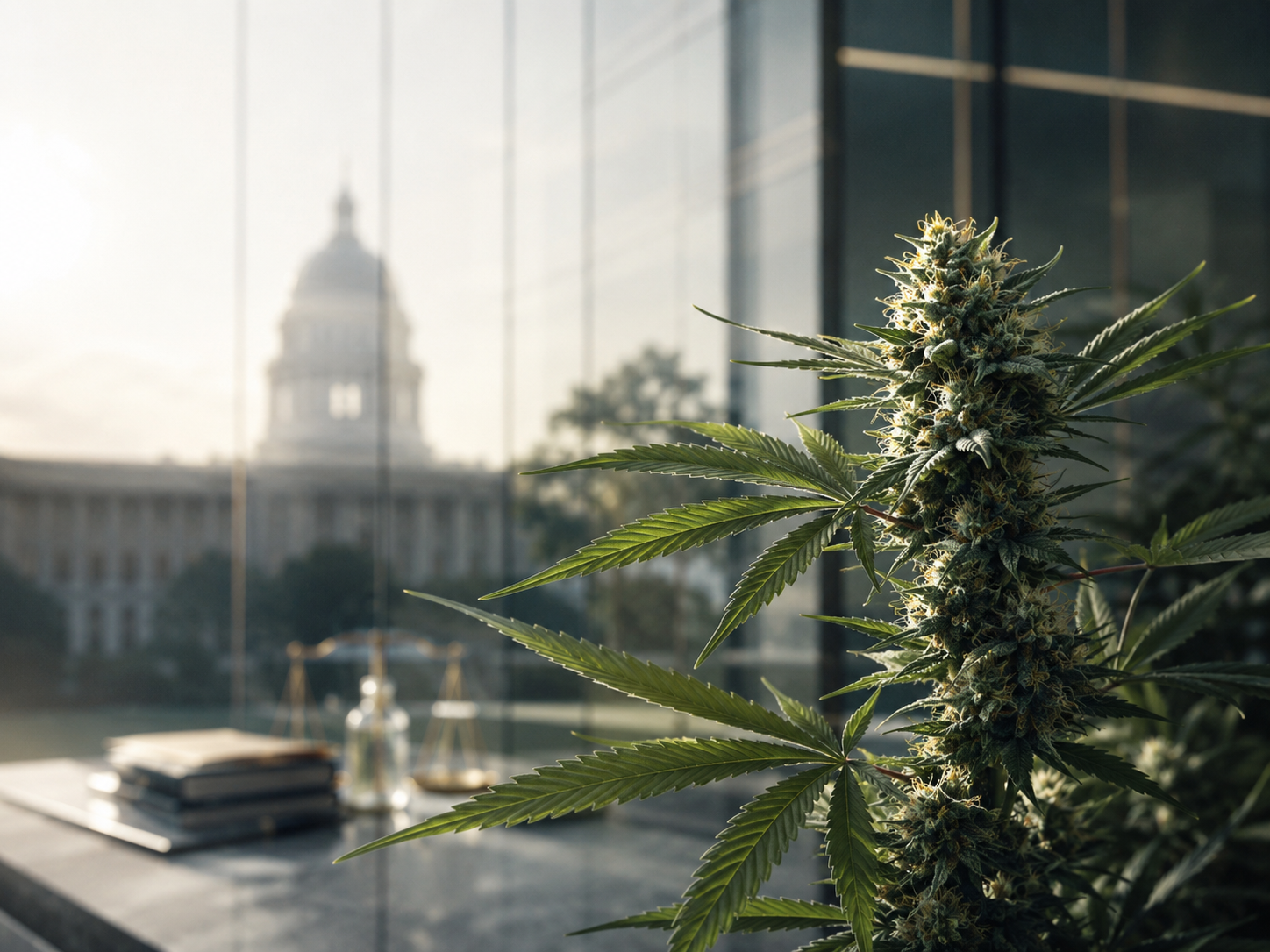

April 2026 · United States · U.S. / Federal
The United States is finally moving cannabis into a new federal phase, but this is not full legalization. That is why this month matters: cannabis is no longer just a cultural argument or an investor fantasy. It is becoming a regulated, measurable and politically sensitive sector where the details decide who survives.
The mood right now
The immediate business effect is credibility and potential tax relief for qualifying medical activity, not a national free market. The conversation around cannabis is becoming more serious because the consequences are becoming more serious. A new rule can change consumer access overnight. A tax interpretation can decide whether a licensed business makes money or bleeds cash. A local enforcement memo can matter more than a national speech. This is the part of the cannabis story that casual observers often miss: legalization is not a switch. It is a operating system.
Across the market, the loudest claims are becoming less useful. The important questions are practical. Who is allowed to grow? Who is allowed to sell? Who can advertise? What documents must be kept? Which products can be prescribed, distributed or consumed? What happens in public spaces, cars, workplaces and rental apartments? Those questions do not sound like lifestyle branding, but they define the real market.
The numbers and rules behind the story
- In April 2026, federal action moves parts of cannabis policy toward Schedule III treatment for FDA-approved cannabis products and state-regulated medical cannabis while broader marijuana rescheduling remains subject to process.
- The change is significant for medical operators because Schedule III status can affect the Section 280E tax burden.
- Recreational cannabis, interstate commerce and full federal legalization are not solved by this move.
These details matter because they show where the market actually is today. Cannabis is often discussed emotionally, but the industry is shaped by quantities, dates, limits, medical definitions, licensing categories, tax rules and enforcement capacity. In a young regulated sector, every number becomes a border. A possession limit is a border. A plant count is a border. A prescription requirement is a border. A tax rule is a border. A lab threshold is a border. The companies and consumers who understand those borders make fewer expensive mistakes.
There is also a second layer: public trust. Regulators do not only watch whether cannabis can generate revenue. They watch whether youth access increases, whether impaired driving becomes a visible problem, whether hospitals and doctors report new pressure, whether local communities complain, and whether licensed operators behave better than the illicit market. That is why the market cannot win by access alone. It has to prove control.
What this means for businesses
For operators, the current environment rewards boring excellence. That means clean records, conservative claims, documented sourcing, staff training, realistic financial planning and a strong understanding of local law. It also means not confusing demand with permission. Many people may want a product, but demand does not create legality. The cannabis sector has learned this lesson repeatedly: the market may be ready before the law is ready.
The strongest business models are therefore being built around resilience. A resilient cannabis company can survive price compression, slower licensing, political pushback, supply interruptions and stricter audits. It knows the difference between hype traffic and durable customers. It can explain its compliance process in plain language. It can adjust when a ministry, federal agency, health authority or local regulator changes course.
That is why the most valuable cannabis companies are not always the most visible ones. The real advantage may sit in pharmacy logistics, cultivation consistency, lab testing, patient acquisition, legal software, education, traceability systems, club administration, tax planning or medical documentation. The consumer sees the flower, oil, capsule, edible or CBD product. The market is built underneath it.
What this means for consumers and patients
For patients, the federal signal matters because it recognizes medical cannabis systems more directly than before. For adult-use consumers, state law still does most of the practical work. The safest consumer is now an informed consumer. That means knowing the local rules before buying, carrying, growing or consuming. It means understanding that cannabis rules can change between countries, between states, between cities and sometimes even between private and public spaces.
For patients, the core issue is still access with dignity. Medical cannabis works best as a healthcare pathway, not as a loophole with a doctor’s name attached. Good access includes a real consultation, suitable product selection, clear dosing guidance, follow-up, pharmacy reliability and honest discussion of side effects. When medical systems are weak, patients are pushed into informal markets. When systems become too loose, regulators push back. The balance is difficult, but it is the center of the medical cannabis debate.
For adult-use consumers, the lesson is similar: legalization does not remove responsibility. It creates a legal space where responsibility becomes visible. A legal adult should be able to understand where consumption is allowed, how much can be possessed, when not to drive, how to store products away from minors and why stronger products require more caution.
The cultural shift
The cultural story is changing as well. Cannabis is still surrounded by identity, music, wellness, activism and counterculture, but it is also becoming a subject for lawyers, doctors, pharmacists, tax advisers, farmers, software developers and municipal offices. That does not make the plant less interesting. It makes the market more mature.
The old cannabis conversation often asked whether the plant should be accepted. The new conversation asks what acceptance should look like in practice. Should supply be commercial, non-profit, medical, pharmacy-based, club-based or home-grown? Should advertising be allowed? Should edibles be treated differently from flower? How should governments separate adult access from youth protection? How much enforcement should remain? Which data should decide whether a law is working?
These are not small questions. They determine whether cannabis becomes a trusted regulated category or stays trapped between prohibition, loopholes and moral panic.
The risk nobody should ignore
The biggest risk right now is overconfidence. Businesses can overestimate how much regulators will tolerate. Consumers can overestimate how simple the new rules are. Investors can overestimate how quickly political reform becomes revenue. Governments can overestimate how easily enforcement can adapt. Media brands can overestimate how much readers still want shallow strain hype instead of real guidance.
In this market, mistakes are rarely abstract. A bad compliance decision can cost a license. A bad medical claim can trigger enforcement. A weak supply chain can create product recalls. A poor education strategy can create political backlash. A misleading article can damage public trust. Cannabis is becoming more legal in many places, but it is not becoming less regulated.
What to watch next
The next battle will be legal challenges, DEA process, medical registration requirements and whether broader rescheduling follows. The next phase of cannabis will be decided by implementation, not slogans. Watch the practical details: registration deadlines, club approvals, prescription rules, tax treatment, lab standards, enforcement patterns, political reviews, patient numbers, pharmacy stock, retail closures, price movements and public-health data.
The most important cannabis stories are no longer only about whether reform happens. They are about whether reform works. That is a more demanding story, but it is also a more useful one for readers, patients, consumers and serious businesses.
The American contradiction
The United States remains the clearest example of cannabis normality and cannabis illegality existing at the same time. State markets can look mature from the street, while federal law still shapes taxes, banking, research, investment and interstate movement. Any federal change matters because the current contradiction is not just philosophical. It is expensive.